
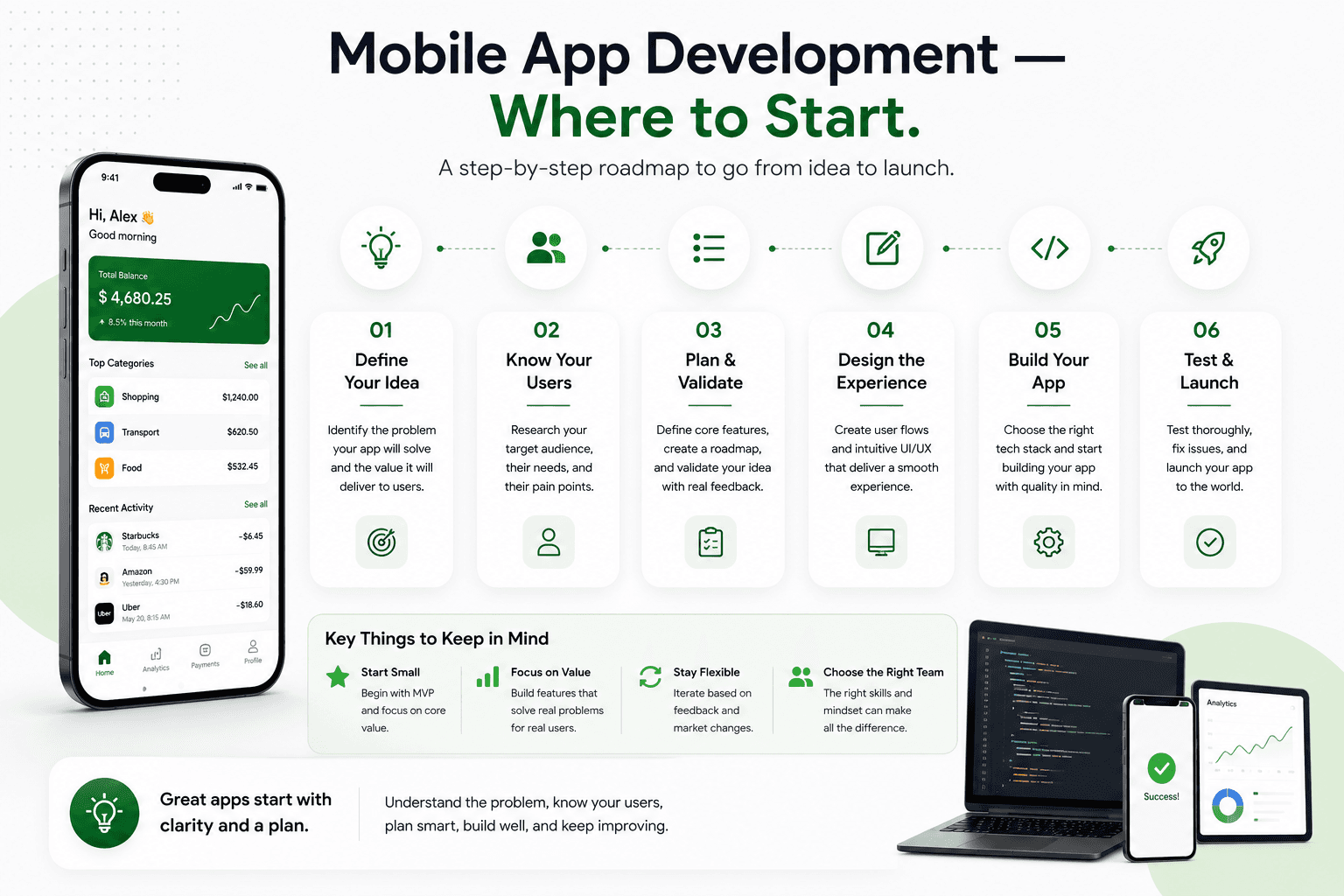
Mobile app development is the process of taking an idea from a sketch to a finished app on a real phone. For most founders, the hard part is not the code. It is the long list of small choices before any code is written — and most of those choices shape the cost of every sprint that follows.
A good first build keeps the idea small and the timeline short. The first version should live on a real phone in weeks, not in long months.
.png&w=3840&q=75)
The right mobile app development partner does not start with code — they start with the right questions, asked in the very first call.
Start with the idea, not the stack.
The first call should be about the user, the problem and the goal. Tech choices come later, and they should follow the product — never the other way around.
A senior team will push back, ask the right questions, and shape a small first version. The goal is the smallest app that solves the real problem, not the biggest one possible.
Pick the platform that fits users.
If most users are on iPhones in the US, UK or Singapore, an iOS build first often makes sense. If the audience is mostly India, Africa or South Asia, Android leads.
When the user base is split or unknown, cross-platform development can ship both stores with one team. A senior partner will help you pick iOS-first, Android-first, or a shared codebase on the first scoping call.
What a clean first build looks like.
A short scoping call. A clear screen list. A small Figma. One repo, one team, weekly Friday demos on a real phone. The founder always knows exactly where the build stands.
No long silences. No "we will show you in four weeks". The first version should be on a real device by the second or third sprint at the latest.
QA, store submission and the boring-but-critical post-launch work are owned by the team. The founder only signs in to their own developer accounts to approve the final submission step.
What slows most app builds down.
Scope creep is the biggest one. Every "small extra screen" added mid-sprint pushes launch back by weeks. A senior team will gently say no, or move it to a clear post-launch list.
The second is decision lag. If a founder cannot review demos on time, the build slows down. Weekly demos work only if both sides show up for them.
The third is hiding bad news. A serious team flags risk early and openly. Surprises near launch are almost always the result of silence earlier.
What you should own when it ships.
You should own the code, the design files, the App Store account, the Play Store account and every login. A serious team hands all of this over without question.
After launch, the team can stay on a small monthly retainer for updates, or you can take the code in-house. The choice is always yours alone. Share your idea here.
Need a human sooner than later? contact us through the quote flow, and skim about Kriva.studio if you want context on the team first.